Draft Kings Hill Masterplan and Design Code Supplementary Planning Document
2 Vision
2.1 Supporting Warwick District Council’s Priorities
The Local Plan’s vision prioritises shaping sustainable development across the whole district, balancing economic prosperity, housing delivery, environmental protection, infrastructure provision, and community wellbeing so Warwick District remains a desirable place to live, work, and visit now and into the future.
2.1.1 Warwick District Council’s priorities
The Local Plan’s vision is delivered through several strategic priorities that reflect the district’s long-term development goals:
- Improving Quality of Life
- The Plan supports safer, healthier, fairer and more prosperous communities across the district.
- Aligning with the Sustainable Community Strategy.
- The Local Plan is structured around five priorities to improve overall wellbeing: Safer communities, health & wellbeing,
- Balanced and Sustainable Growth.
- Promote balanced economic and housing growth to meet local needs and support businesses.
- Provide sufficient land for homes (including affordable housing) and jobs.
High-Quality, Location Appropriate Development
- New development should be well-designed, located to reduce car use, encourage walking/cycling, and address climate change and environmental impacts.
Infrastructure and Services.
- The Plan aims to enable improvements to infrastructure (transport, schools, utilities, community facilities) to support growth sustainably.
- Protecting and Enhancing the Environment
- There is emphasis on conserving natural and historic assets, improving habitats, and enhancing open spaces.
At the centre of these principles are 3 strategic priorities:
- Delivering valued, sustainable services
So that the Council can continue to focus its efforts and activities on the needs of its residents, communities and businesses, this priority will be underpinned by continued demonstration of financial sustainability through the medium term. This is the foundation for ensuring there are resources to continue to enable residents to receive excellent high-quality services that are responsive and accessible to local needs.
- Low cost, low carbon energy across the district.
The Council will look to find ways to reduce energy consumption and bills in Council civic buildings, Council housing, and help others to do the same, such as privately owned homes, businesses and other public and voluntary sector organisations. Support programmes and initiatives will be developed that meet national standards of accreditation to ensure performance in use is optimised. A performance measurement approach will be developed to assess the long-term benefits
- Creating vibrant, safe and healthy communities of the future
We will work with communities, businesses and public sector partners to enable and support improvements where people’s community, economic and housing needs can be met. This will facilitate a better and more sustainable balance with the natural world that will allow our communities and businesses to thrive in a sustainable and safe way.
“To make Warwick District a Great Place to Live, Work and Visit."
- Sustainability will be at the heart of our decision making.
- Plan and invest for the long-term benefit for the people and environment of the district.
- Good governance and transparent decision making.
- Use data, including insight from our customers, residents, businesses, and visitors to help us make the right decisions.
- Social value and inclusive growth will underpin the investments we make throughout the district to help ensure all our communities prosper.
- Consultations and engagement with stakeholders will be used to help inform and share how we deliver improvements and change.
- We will evaluate how we make the best use of resources to offer the best service at the best value.
2.2 Vision for King’s Hill Lane
King’s Hill Lane is an exceptional location providing the opportunity to create a new, distinctive, and liveable community.
Envisioned as a characterful and memorable place, the neighbourhood will foster a strong sense of identity and pride, becoming a place where people aspire to live, grow,
and put down roots. Designed to support intergenerational living, it will cater for people of all ages and life stages, nurturing a balanced, inclusive, and resilient community.
At the heart of the vision is the creation of a walkable, people-first neighbourhood, shaped around high-quality streets, welcoming public spaces, and a rich mix of community facilities. Safety, comfort, and inclusivity will be embedded in the design, ensuring the neighbourhood feels open, welcoming, and easy to navigate, encouraging everyday social interaction and a strong sense of belonging.
Set within a landscape of mature woodland of Wainbody Wood, the development will be sensitively woven into its surroundings, offering generous green views and access to a network of high-quality open spaces.
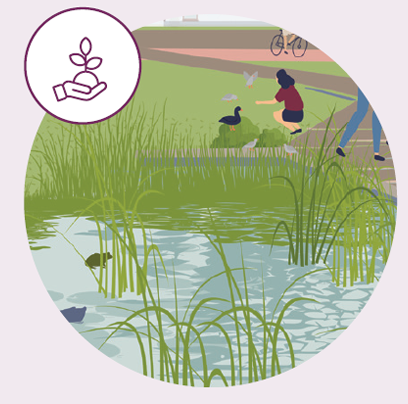
A connected framework of ecological corridors will run through the neighbourhood, connecting Wainbody Wood to Finham Brook enhancing biodiversity, strengthening habitats, and allowing nature to flourish alongside everyday life. Active and healthy lifestyles will be promoted through enhanced sports pitches, leisure facilities, and attractive walking and cycling routes.
Enhancing the connections towards the city and public transport will position Coventry within easy reach, while the neighbourhood itself offers greenery and a calmer pace of life.
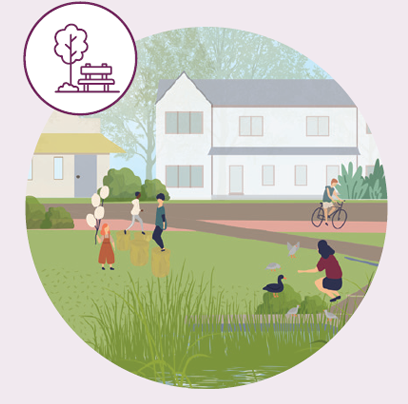
King’s Hill Lane will create a rich variety of experiences, from quiet, reflective spaces immersed in nature to vibrant places where children can play, neighbours can meet, and communities can thrive.
A Walkable, Connected Community
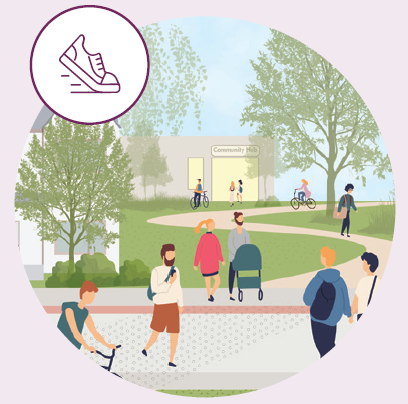
Prioritise walkability and permeability, with safe, legible streets and attractive walking and cycling routes connecting homes to local facilities, green spaces, public transport, and neighbouring communities such as Finham. Movement networks will reduce car dependency and support sustainable travel choices.
Characterful Places People Are Proud to Call Home
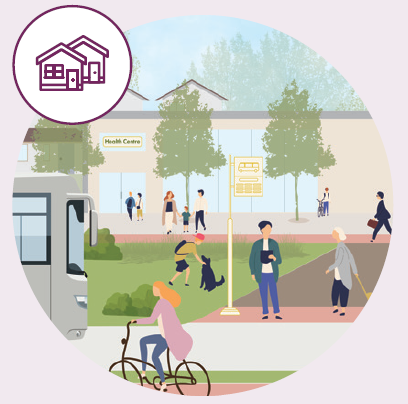
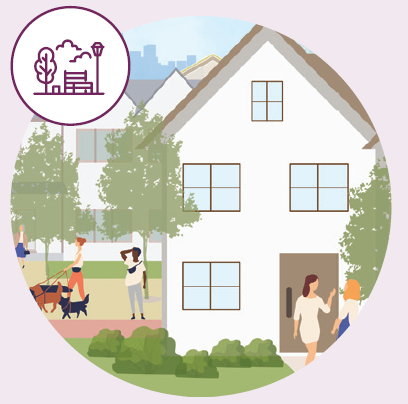
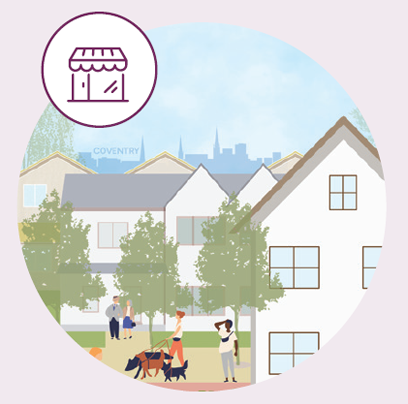
A varied and high-quality built form will create a characterful neighbourhood with a strong sense of place. Streets, squares, and spaces will be designed to feel human in scale, memorable, and welcoming in character, fostering long-term pride and stewardship among residents.
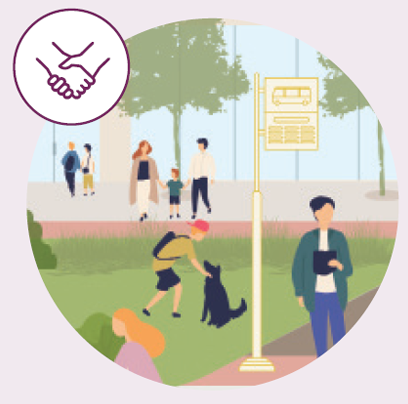
Safe, Welcoming, and Sociable Streets
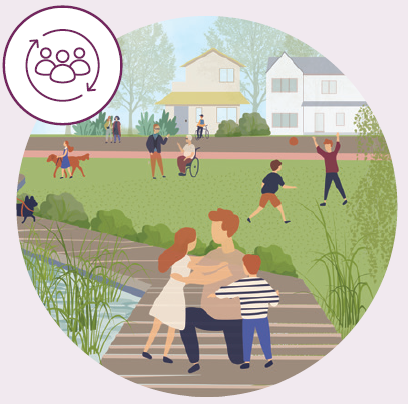
Public spaces and streets will be designed to feel safe, overlooked, and welcoming at all times of day. Clear sightlines, active frontages, and well-defined public and private realms will encourage social interaction, reinforce security, and create places where people naturally meet and dwell.
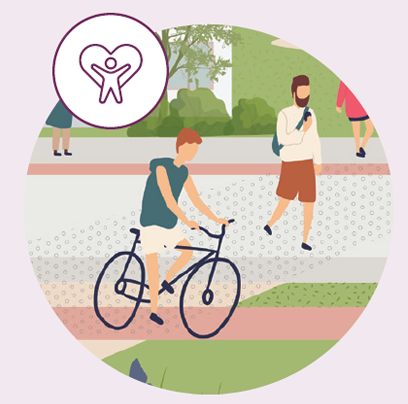
Healthy and Active Lifestyles
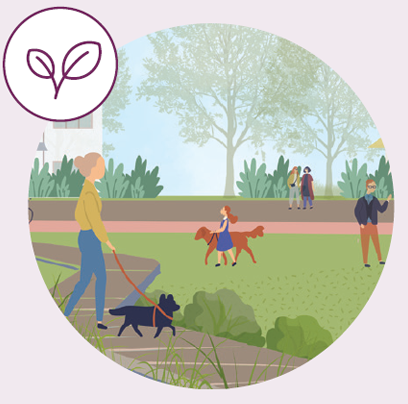
The neighbourhood will actively promote health and wellbeing through access to green spaces, enhanced sports pitches, leisure facilities, and a connected network of walking and cycling routes which will be embedded into the design, supporting healthier lifestyles for all residents.
2.3 King’s Hill Lane Masterplan
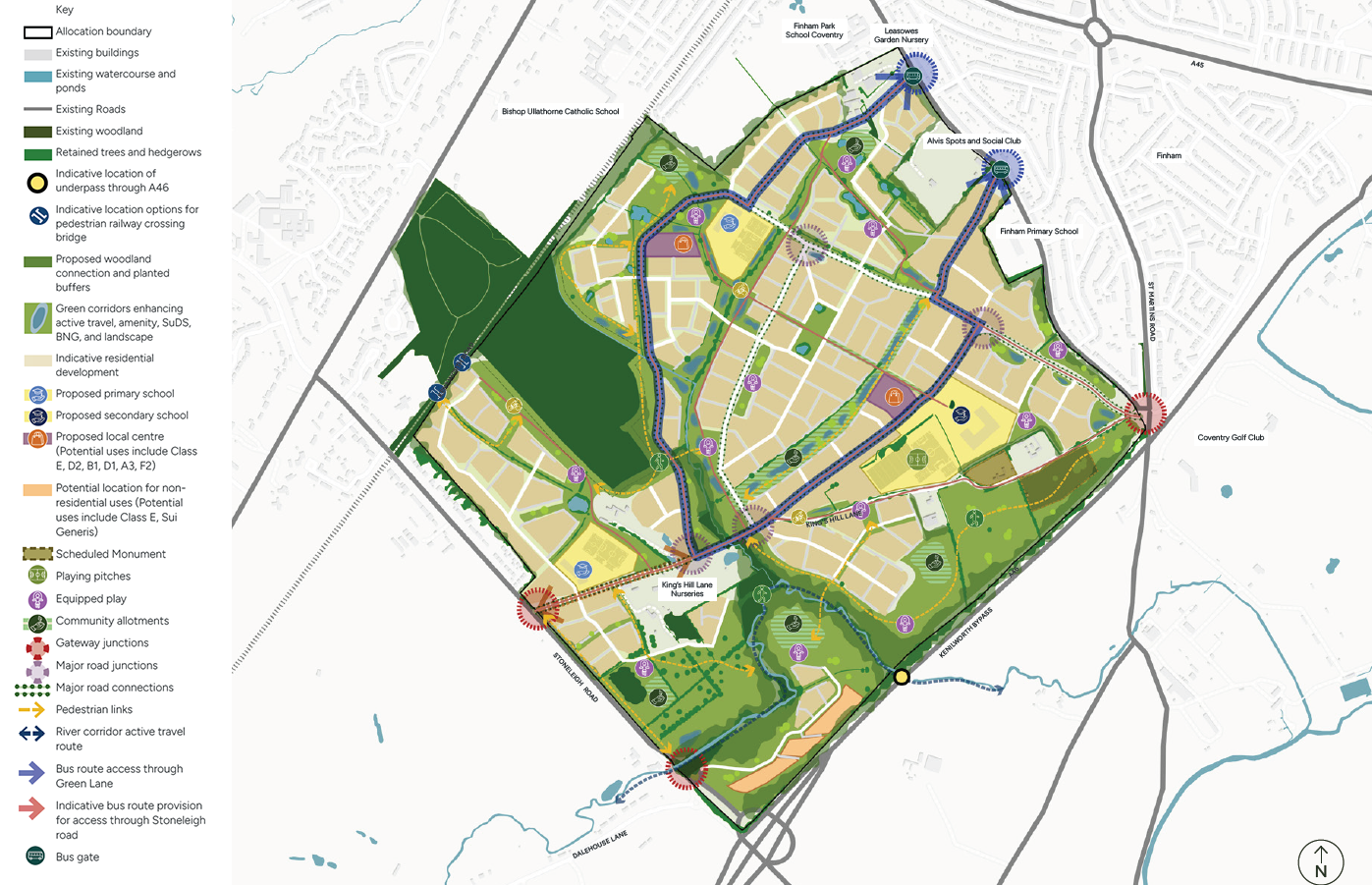
A comprehensive illustrative masterplan has been produced alongside the design code.
The illustrative masterplan, figure 12, sets out key development principles for the site. Below describes the features of the masterplan.
2.3.1 Masterplan Design Principles
Green Infrastructure and Landscape
- Wainbody Wood south will be retained and enhanced, supported by appropriate buffer planting to protect ecology.
- A continuous north-south green corridor will connect Wainbody Wood with Finham Brook woodland and the wider open space network.
- Strategic areas of open space will provide landscape and ecological connections between Wainbody Wood and Finham Brook.
- A riverside walk and nature route will be delivered along Finham Brook, balancing public access with biodiversity enhancement.
- Existing mature landscape features will be retained and integrated to deliver Biodiversity Net Gain (BNG) in accordance with statutory requirements.
- Landscape buffers adjacent to the A46 and railway line will mitigate noise and visual impacts while supporting biodiversity and habitat connectivity.
Movement, Access Connectivity and Active Travel
- East-west green links will enhance permeability and promote walking and cycling across the site.
- Safe and direct north–south pedestrian and cycle connections will provide access to the secondary school and key community facilities.
- Footbridges located at Finham Brook will improve access to public transport routes and key amenities.
- The existing bus network will be extended and realigned to ensure all homes are within convenient walking distance of public transport.
- Future opportunity for a footbridge over the railway to enhance connectivity towards the north, promoting active travel to the university, shopping facilities and schools.
- Vehicular access will be provided from Stoneleigh Road via King’s Hill Lane.
- Vehicular access will also be provided from Green Lane, connecting to the new roundabout
Community, Health and Wellbeing
- Two centrally located community hubs will include schools, mixed-use centres and parks, located within walking distance of homes to promote active travel and reduce car dependency.
- Play parks will be integrated within walking distance of homes and along key pedestrian routes to support children’s health and wellbeing and ‘play-on-the-way’.
- Allotments will be provided as part of the green infrastructure network to promote community interaction and food growing.
- Two new primary schools and a new secondary school will be delivered as part of the development.
- Potential for non-residential uses (including Class E, Sui Generis) to form transition between the residential neighbourhood and Kenilworth bypass.
- Heritage and Character
- Public open space within the setting of the Scheduled Ancient Monument will incorporate opportunities for heritage interpretation and education.
- King’s Hill Lane will retain its rural character, supported by enhanced pedestrian and cycle connectivity.